A story helps you remember
You remember enterrement because in the story Sophie holds a funeral for her doll. A word you learn from a vocabulary list, with no story around it, is easier to forget.
Free beta · iPhone and iPad
Read real books in French, German, Spanish or English, from the first chapter to the last. Before each page you learn its new words, so you can follow the story. Questions and a short daily review help you remember them.
Have you ever tried to read a book in a language you’re learning?
There’s an unknown word in almost every sentence. You look them up one by one, lose the story, and put the book away.
PréLire teaches you the new words first, a page at a time. Then you read that page and follow the story. If you get stuck, tap any word or sentence to see what it means.
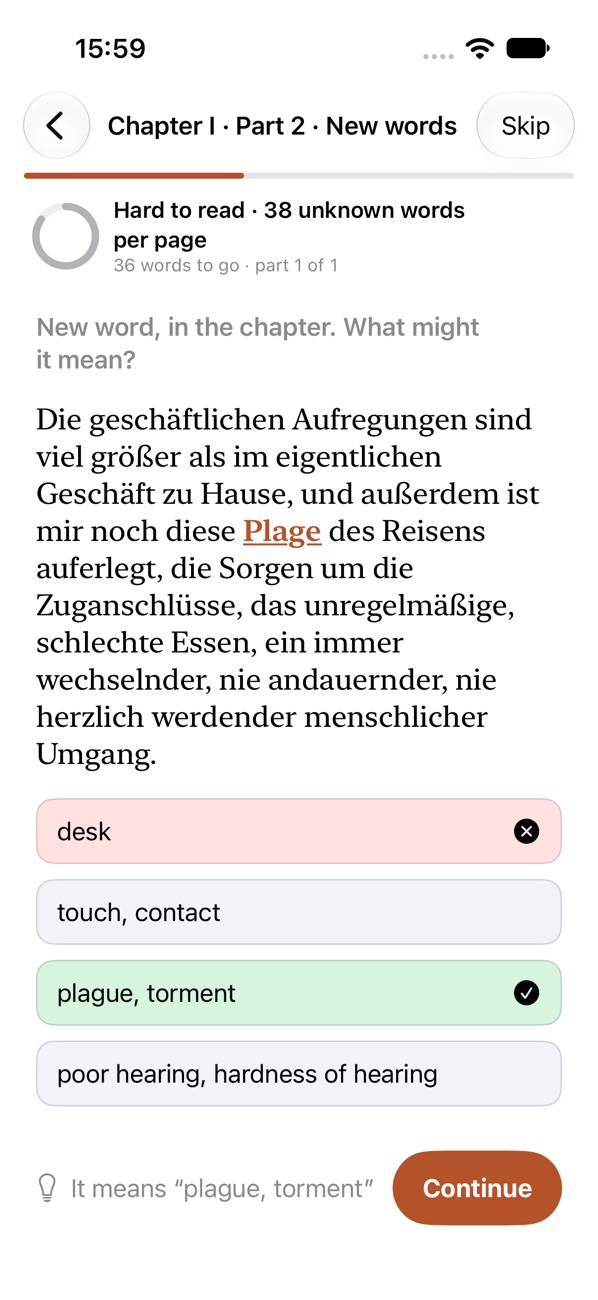
You go through a chapter a page at a time: first that page’s new words, then the page itself. It works the same way for every chapter of the book.
Before each chapter, PréLire picks the ten to thirty words in it you most likely don’t know yet.
Seen a word before but not sure what it means? Tap “Check me” and pick its meaning from four choices.
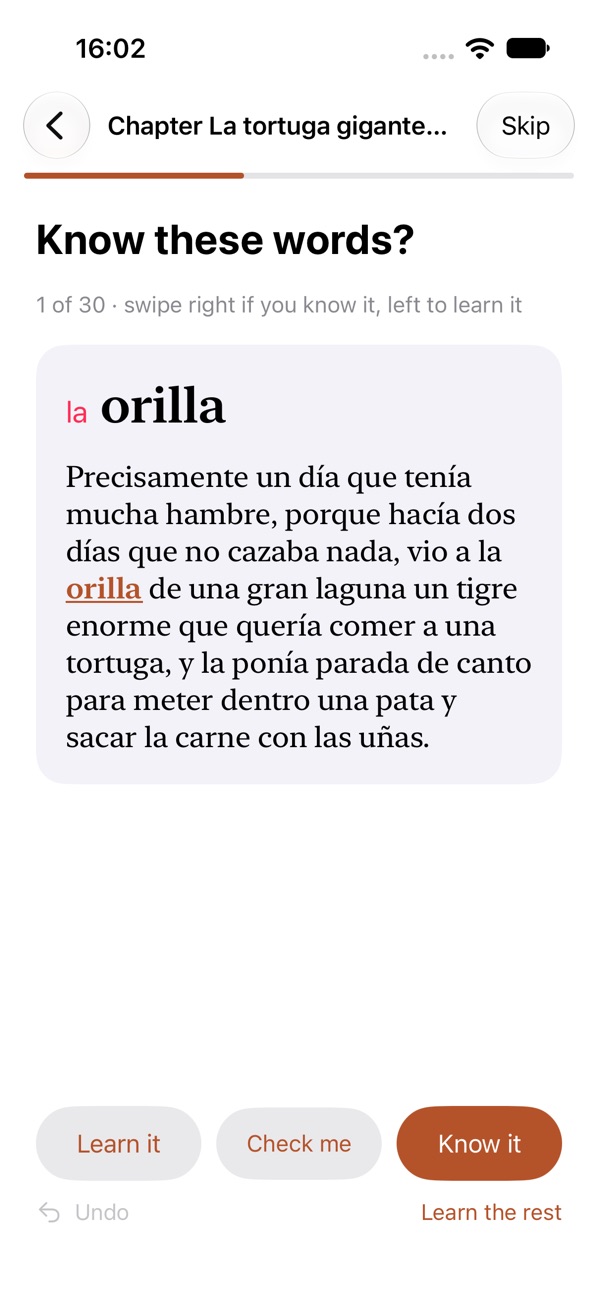
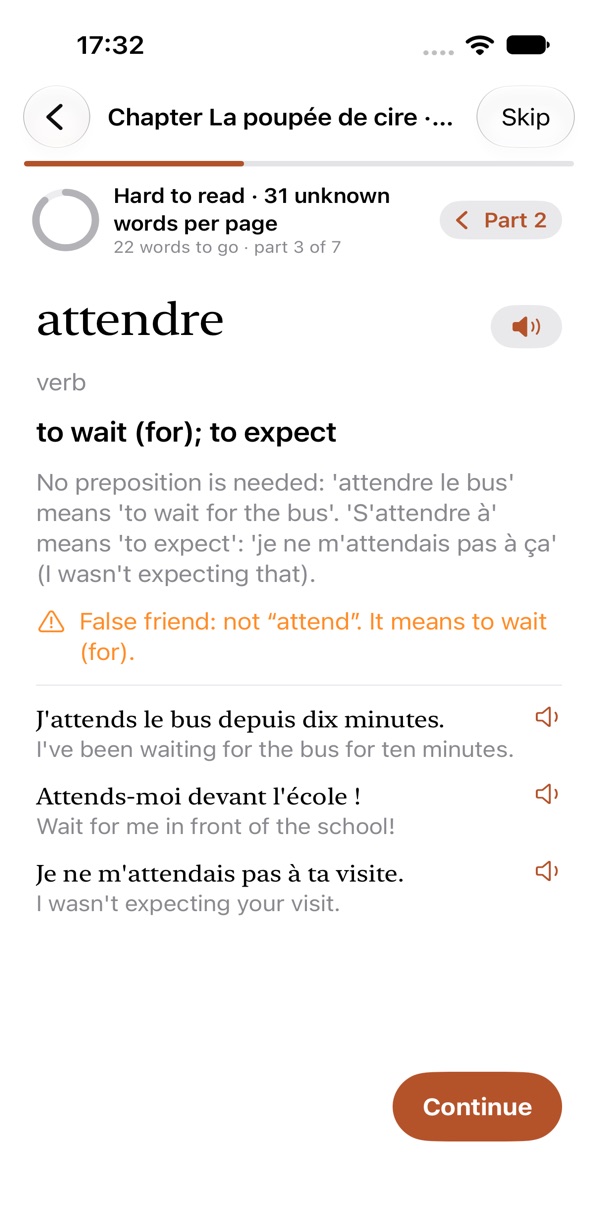
Each word comes with the sentence it appears in. You guess what it means, see its card and hear it. False friends get a warning: attendre means to wait, not to attend.
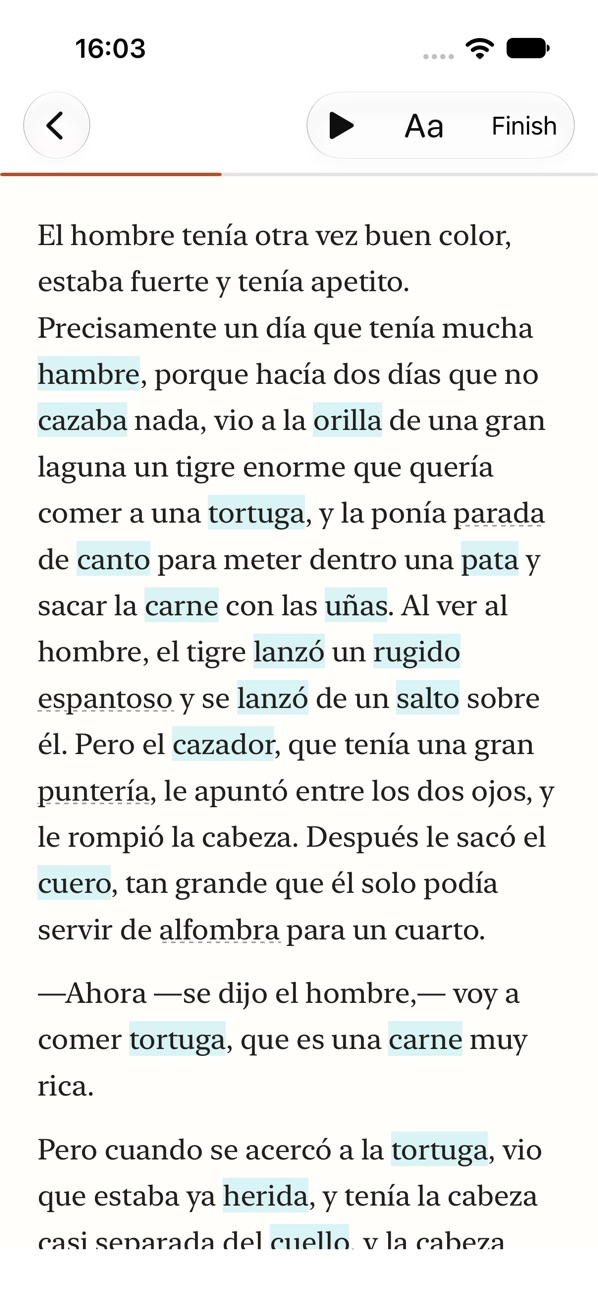
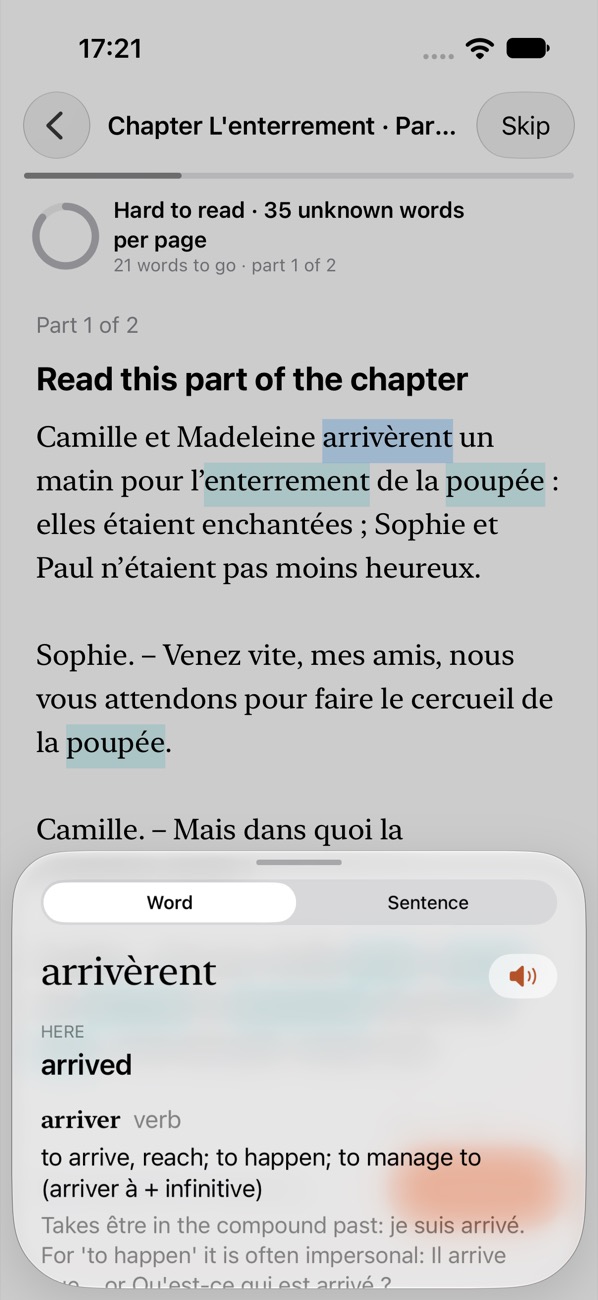
You read the page from the book, with its new words highlighted, and check that you know what they mean there. Still stuck somewhere? Tap any word to see what it means in that sentence, or switch to the whole sentence in your language. Want to hear it? The app reads it aloud. You can stop after any page and go on later.
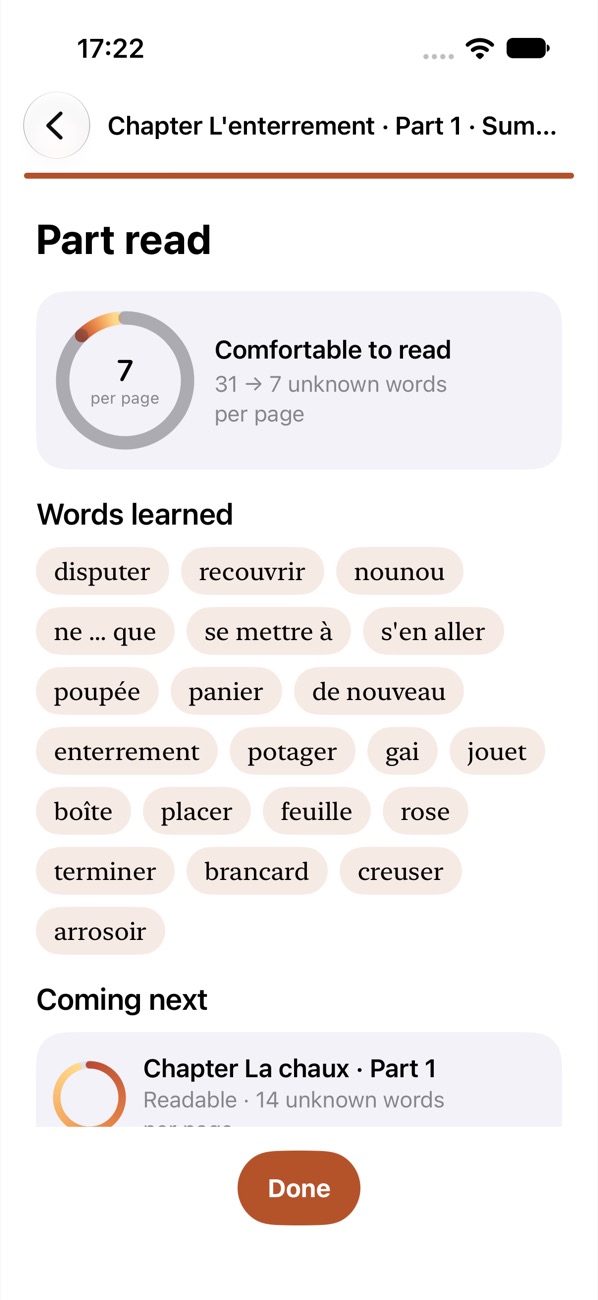
A few questions check that you followed the story, and you repeat a few sentences aloud. At the end, the app shows your progress, such as how many unknown words a page had before the lesson and how many it has now.
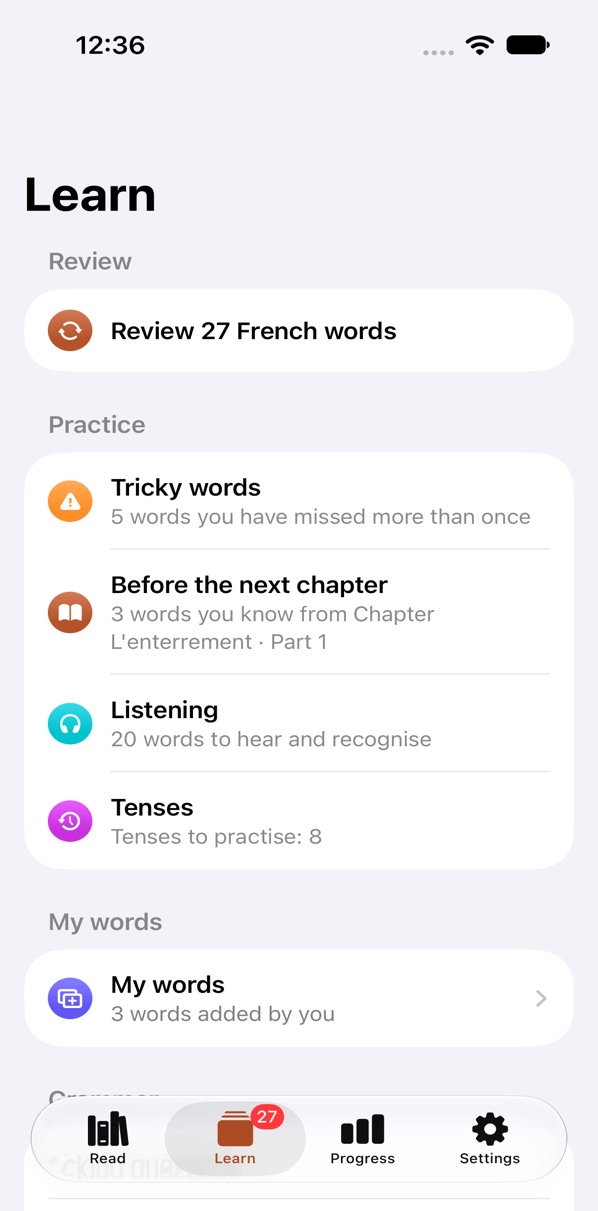
Every day there’s a short review of the words you have learned. You choose meanings, fill gaps in sentences from your book, listen, type and repeat sentences aloud.
PréLire keeps track of which words are hard for you and shows them more often. You can also practise the words you miss most, the words of your next chapter, or listen only.
Verb tenses have their own practice. Once your books have used two tenses, say the passé simple and the imparfait, you see a verb in a sentence you have read and pick its tense. Progress shows which tenses go well and which need more work.
You can also add words of your own, from a film or a conversation. Type the word and PréLire suggests it from its dictionary, with the gender and a meaning you can change. It then comes up in your daily review with the rest.
You remember enterrement because in the story Sophie holds a funeral for her doll. A word you learn from a vocabulary list, with no story around it, is easier to forget.
The same words appear again and again in a book, so the first chapters need the most new words. By the middle you mostly just read.
Read classic books in the original or in a modern version with outdated words replaced.
Set a goal: a chapter, ten minutes or twenty. The app counts your days in a row and saves where you stopped.
Add an EPUB or PDF you own. The app checks each chapter for words that are new to you and makes lessons from them, on your phone. The file is never uploaded.
Nothing to sign up for in the app. Your progress stays on your phone or iPad.
You finish books you wouldn’t have managed on your own. The first chapters take the most work; after that you mostly just read. Progress shows how many words you know and how many unknown words per page are left in each chapter of your book. And the words you learn from books are the same ones you need for films, newspapers and conversations.
Classic books and a short starter story in each language. The French, German and Spanish books are explained in English, and the French and Spanish ones also in German. The English books are explained in French, German or Spanish. More are on the way, and you can ask for the one you want right in the app.
A PréLire story, 2026
A librarian finds an old photo in a box of books and follows the trail through a French village and its past.
Comtesse de Ségur, 1858
A curious, headstrong girl grows up in a French château with a wax doll, a garden full of animals and a great many bad ideas.
Alphonse Daudet, 1869
Letters from an old windmill in Provence: goats and wolves, a stubborn mule, shepherds under the stars and village priests.
A PréLire story, 2026
In a small hotel, a grey cat called the General disappears every afternoon. One day he comes back with a mysterious letter.
Jacob and Wilhelm Grimm, 1857
Twelve well-known fairy tales, from Little Red Riding Hood to Snow White, in today’s German.
Franz Kafka, 1915
Gregor Samsa wakes up one morning as a huge insect. His family has to live with it. So does he.
Heinrich von Kleist, 1810
A horse dealer loses two horses to a nobleman’s steward and sets out to get justice. How far will he go?
Lewis Carroll, German translation 1869
Alice follows a white rabbit down a hole and lands in a world of talking animals, a mad tea party and a queen who plays croquet. In today’s German.
A PréLire story, 2026
Pictures appear on the walls of a quiet Spanish town overnight. A teacher and her curious friend want to find out who paints them.
Horacio Quiroga, 1918
Eight animal stories from the jungle of northern Argentina: a turtle carries a sick hunter, flamingos go to the vipers’ ball. Short, funny and sometimes stern, like fables.
Benito Pérez Galdós, 1878
In a mining district in northern Spain, a poor orphan girl guides a blind young man on his walks through the countryside.
A PréLire story, 2026
Every Friday, a black box with a cake appears on the basketball court of Green Street. Nobody knows who leaves it.
Flora Annie Steel, 1918
Fifteen tales English children grow up with: the Three Bears, the Three Little Pigs, Jack and the Beanstalk, Little Red Riding-Hood, Dick Whittington and his cat.
L. Frank Baum, 1900
A cyclone carries Dorothy and her dog Toto from a grey Kansas farm to a strange, colourful land. To get home, she follows the yellow brick road to the Emerald City.
Arthur Conan Doyle, 1892 · the first six stories
A king who wants a photograph back, a man paid to copy out an encyclopedia, a bride whose groom disappears. Holmes notices what everyone else misses.
PréLire is free while it’s in beta. Leave your email and we’ll send you an invitation through TestFlight, Apple’s app for trying apps before they launch.
Very little. Each language has a short starter story for beginners. Other books start at about A2, roughly 1,500 words, or B1, about 3,000; each book shows its level. A short reading check at the start tells you how each book will feel for you.
Nothing during the beta.
Not yet. iPhone and iPad come first.
French and Spanish, explained in English or German. German, explained in English. English, explained in French, German or Spanish. The app itself speaks your language: English, French, German or Spanish. More languages will follow.
No. You can switch to the original wording whenever you like. The modern version only updates old spellings and words nobody uses anymore. The story and the style stay the same.
Download a better voice on your iPhone or iPad: open Settings › Accessibility › Read & Speak › Voices, choose the language you are learning and download a voice marked Premium or Enhanced. PréLire then uses the best voice installed.
Yes. There’s no account and no tracking. If you agree, the app sends a few anonymous counts, such as “a lesson was finished”, so we know what works. Details.